Friday, June 17, 2022


There's Gold in them thar swamps!


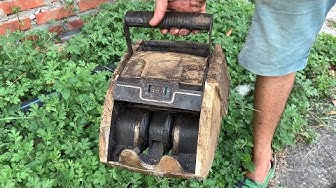
Watch enough YouTube and you will see a place where old electronic junk is repaired and renovated using little more than running water, a few screw drivers and boundless determination.

I've watched a few of these miraculous rebirths and have a few ideas about how these are staged and carried out.


First, lets set the stage: an Asian man, age unknown, is scuffling through an unnamed Asian country, looking at trash.

 He often comes to an impromptu  trash site where someone of means has discarded a valuable piece of electronics: Ear Buds, an air conditioner, an old Sony PlayStation, etc. Sometimes his travails are accompanied by jaunty music.


The man dutifully takes his dirt-encrusted prize back to his workshop, which is down a tree-lined boulevard, a few less wholesome streets, and ends at his red tiled abode.  I might note that all of these finds are covered with the same kind and color of soil.  We'll come back to that.


There, within sounds of hens clucking, children making low screams, and snippets of conversation in whatever language is spoken wherever this takes place.    The find is immediately disassembled using screw drivers, some hex wrenches and little else. Once I saw an electronic meter.

Wiring was promptly removed and cast aside. 


Occasionally sandpaper is used, along with gallons of fresh water.  Recently the show presented a discarded Toshiba air conditioner.   Lugged back to the shop was a stained, rusty object, with some actual parts of air conditioners -- a compressor, a reservoir for coolant, some valves,  a fan and a large propeller.  

The air conditioner was completely unassembled, scraped free of paint and a screen was washed with water. More clucking and screaming.  After the gross dirty was removed, using ubiquitous white power. (Soap I imagine), the parts were spray painted with a red primer followed by a coat of white paint. 

The cast aside electronics were cleaned with water and some removed fittings were reattached to the mechanism by braising.   Wires were reattached, someone  soldered a circuit board, and that's that. 

Then a rusty tank of coolant, I'm assuming, was connected to the brass fittings and turned on.  No telltale hissing was noted. 


The last scene is  people huddled around an apparently working air conditioner.

Here's what I think. This is only a theory.  (I don't want legal suits,) 

Someone higher up the food chain selects new or slightly used consumer electronics. He or his minions take them and dip them in mud, and possibly daubed them with some other easily removable soil.  Then they plant the "broken" whatever in a trash heap.


The alleged renovator is told were the whatever is and he tromps around until he finds it and heads home of the red-tiled workshop.  The mud easily rinses off in most cases. So do many "rust" stains etc.  Then the magic happens.

Ear Buds caked with muck come out looking brand new, as does most everything they renovate.  So, this renovation is theater. Entertainment. As such, who am I to criticize?


Wednesday, June 23, 2021

The Sounds of Summer


Ah, the sounds of summer, a summer now almost free of Covid-19.

The sweet song of the ice cream truck, the cooing of doves, the reverberating bounce of a basketball, the shrieks of kids doing whatever kids do.

The night also has sounds, some good and some annoying.  One of the worst is the hum, buzz, click clacks, and muffled sobs of air-conditioning.  The just-as-you're-fallling asleep blare of the air conditioner cycling. 

 Turning the volume of your television so high that folks a mile away can hear it, so that you can hear it over the air conditioner.


Why are air conditioners noisy? What are all of those dissonant sounds? 

The basis of air-conditioning seems simple: a compressed gas released through a small hole becomes extremely cold.  The heat inside shifts eagerly to the cold air and is then whisked away. Something like that. 

As suggested, an air conditioner has a compressor.  It's there to compress a refrigerant, which means a chemical that destroys ozone, or it used to.  Safer refrigerants are now used.

Once the refrigerant is cold, it is circulated through a series of tubes, which unwound, would be a zillion miles long.  The circulating cold in the tubes takes the heat of the room away.  A fan behind the tubes blowing into the room, helps the process along.  

When the tubes warm up the refrigerant travels to another region of tubes.  There the refrigerant condenses.  This place is called, reasonably, the condenser. It's connected to the cold tubes but on the outside of the window. As you may recall, condensation releases heat.  Another fan helps blow the warm air away, The refrigerant travels back through the compressor and the whole cycle begins again. 

So, that helps explain the noises. The compressor is an electrical device, probably not well shielded for sound, and designed to work non-stop for months or years. The refrigerant is gurgling through the tubes, creating a lessor drumbeat of noise.The fans may be creaky or unbalanced.  The axles that the fans spin on may be a bit warped or twisted.

The cover of the air conditioner is made out of relatively flimsy plastic that vibrates when the compressor, fans, condenser coils, and other relays, switches, and valves click on and off. 

Jamming something, like a wood shim, between the case and the wall or window frame might deaden the vibrations. Or you could wear earplugs -- or just get used to the noise.  

Modern houses, built in the past 50 years, put the compressor outside in a small enclosure. The less noisy parts are inside the house. 


Several decades ago Albert Einstein, the atomic genius, and a an acquaintance,  Leo Szilard, future father of the hydrogen bomb, developed a novel  refrigerator that used heat to create cold. It consisted of three loops containing ammonia, butane, and water.  The device required no electricity.  Einstein was apparently interested in air conditioning due to a accidental release of refrigerant that  reportedly killed a family in Vienna in 1926.  


Einstein and Szilard refrigerator 
diagram


The descendants of the Einstein-Szilard refrigerator are now used in nuclear power plants, where the absence of moving parts more than compensates for the air conditioner's complexity.  

If price were no object could a quiet air conditioner be produced? A quieter one, sure.  It would be packed with noise-dampeningn foam, contain a carefully designed and balanced compressor, and equally precise fans, belts, tubing and so on. The quiet ar conditioner would probably cost as much as a new car, roughly speaking.  

As the greenhouse effect heats Earth to levels unprecedented since pre-history, think about how air conditioning works, about Einstein the inventor, and about how how delicious the sound of the window air conditioner clunking and buzzing away.  


Some air conditioners are quieter than others


Thursday, June 10, 2021

Bitcoin, Money and The World of Make Believe


Confused by Bitcoin?
Of course you are!
That's really the whole point.  If you know about Bitcoin, you are likely a criminal, a would-be criminal, a law enforcement official, or one of the alleged people who created Bitcoin,


I do not understand Bitcoin, despite a perfunctory Google search. Bitcoin is a decentralized, anonymous database, or something like that.  Bitcoin has value because -- like actual money -- some people believe it does.

Speaking of actual money, like dollars and cents, consider how "real" they are.
You carry a wallet full of paper bills and a pocket with a few coins.  Is the paper and alloy inherently valuable? No.

 It represents something.

Money is as confusing and weird as Bitcoin, but we have become used to it,  Eons ago, someone realized that gold is in very short supply and hence, is inherently valuable.  Rarity seems to be the source of value -- supply and demand -- whatever that means.

Our currency is "backed" (?) by gold stored in Fort Knox, or that's how money used to be explained in school.  Seashells and other items were the first money, but they became impractical.  So someone, Adam Smith, perhaps, came up with a representational system.  A one dollar bill represents one actual dollar somewhere. Where? I don't know, but presumably someone like Paul Krugman does. 


Paper money is lighter than silver or alloy coins, so it is, our was, the way criminals bought and sold stuff. Money, inn theory, is untraceable and it is fungible, meaning that it can be used in other ways, like making small paper airplanes.


The New York Times, the newsprint version, explained today that our government was able to trace Bitcoins paid for ransom after cybercriminals seized a pipeline (how?) in the United States. The Department of Justice was apparently able to reclaim a large part of the ransom, by somehow determining the private password of the Bitcoin database or blockchain that the criminals used.

Bitcoin  is virtual, meaning it does not really exist, sort of like Britney Spears or the Royals. The stuff of Bitcoin is stored on servers somewhere, huge conglomerations of computers in storehouses in places like like Utah or Mars. 

So is our "money." So, in fact, is almost everything else not counting private property like cars and houses. I've read about arcane activities such as mining Bitcoin, which would make sense to people who'd understand Bitcoin.

If there are any.


Friday, March 27, 2020

A Magazine For Losers To Feel Like Winners


Our son, Alexander, is a successful adult and is living comfortably in New York. 

We still get his mail occasionally. That's how the latest issue of Inc. magazine entered our house.

I cannot imagine Alex or any other actual businessman or woman, or entrepreneur, reading this periodical. 

Inc. reminds me of Men's Health published by Rodale Inc.

 A magazine about mens' health would certainly be welcome. It would concentrate on aging, diet, obesity, anti-depressants, high blood pressure, cancer of all kinds, infectious diseases, genetics, dental health, and the latest advances in medicines, drugs, sports medicine,  and exercise advice from primary sources.

This version of Men's Health would be a lighter New England Journal of Medicine, with a wry columnist, a few news stories, and some photos. 

As it is, Men's Health, Rodale edition, is not intended for its readers. Articles are about young successful actors, athletes, models and other handsome, trim men. These characters are presented as successful executives or middle managers who want to get ahead. 

Any actual news about men and health that somehow gains access to Men's Health is there by accident. 

Likewise, Inc. is supposedly for middle and junior executives, entrepreneurs, and  business owners of cool merchandise.  Who reads it? Certainly not real executives or entrepreneurs.

No, the readership is made up of tired old coots who wish they were scions of industry. Just as the people who read Men's Health are flabby losers who want to feel sharp. Like all magazines it's cover features lists of numbers: 8 ways to tell if you're poor, 12 things to tell your psychiatrist;  3 signs she's cheating on you, etc.

I have a feeling Inc. is no more.

Pity.


Monday, March 16, 2020

The Difficult Easy Chair

Okay. It's been awhile. 

We live in desperate times, and I'm desperate to write. You know how that is.

 Will anyone read this? Likely not.

Have you ever tried to take apart an inexpensive arm chair? Again, likely not.
We found one on the side of the road, and being frugal, or whatever, carted it back home. I insisted on a 2-week quarantine in the garage to let the infecting fleas, ticks, earwigs, ants, bedbugs, bees, wasps, aphids, et al, escape.  Also mice and other small animals.


This is a much nicer new chair, but you get the idea. Its big.


We dragged it onto the porch, which converted the space into a surreal painting -- tiny room with enormous chair, in the style of Magritte.  Then chair went back got the garage.  We wanted to get rid of it, but once you've taken ownership things get a lot more difficult.

We left it on the curb. No one wanted it. Then it got rained on and No One wanted it. We were stuck with it, but I had a plan of sorts: dissemble he chair and throw it away bit by bit.  Sort of the way POWs got rid of tunnel dirt in movies.

The chair was really a fold-out footrest deal, with a fair amount of metal parts. Those were relatively easy to disengage.  And people want scrap aluminum or steel or whatever alloy that was.

I assumed this thing was made in Canada, largely because the U.S. stopped making furniture when I was about 2 or 3 years old. Deep within the chair, far from any casual shopper's view, was a  small slip of (stapled) piece s of paper, addressed to everyone and no one.

The chair was "45 percent foam...55 percent polyester" -- no talk of wood or metal-- made by El Ran Furniture LTD.../Point Caire, Quebec.

 The chair's serial number, in the event of its being stolen and recovered, was 100225724002.

My wife told me that taking apart the chair was a waste of time and that I would probably injure myself.  However, a person has to do with a person has to do.

El Ran be dammed. 

I took a sledge hammer to it, without much effect. The cloth covering of some synthetic fiber held the rest of the chair together and was surprisingly resilient. Not like a sheet of cotton.  More like bullet resistant  Kevlar.

I pried it apart one snowy evening, leaving three main parts connected by the connective tissue of textile. The carcass had two arms. a back devoid of fill.  It was all wood.  

But it had scant screws and other expensive (?) joiners. Mostly it was held together by staples. 
Not little staples that hold school papers together, although there was smaller sized staples. The plywood and pine of the chair were striven by enormous staples, spread intentionally and also willy-nilly.

Staples held the cloth together, which in turn kept the wood from coming apart.  Like skin. 
No, this was nothing like dissecting a body. Not even close.

I imagined the El Ran factory floor: young blond, scruffy men with staple guns, lunging and stapling in a mad cloud. Occasional laughter and swearing as they installed staples in devil-may-care insouciance.


This small piece of plywood had numerous staples. Was this necessary?


I removed staples by hammering the backsides of plywood, prying them loose with a crowbar and smaller similar tools. Leverage was usually tricky, as you could imagine. Brute force sometimes worked, but often left half staples, sharp as needles sticking out of the wood in unpredictable places.

I began to imagine how it was built. The workers don't call them staples, I'm sure. They are either "connectors" or some  Canadian slang only known to chair assemblers. How are the staples installed? My mind sees young (blonde) men going crazy with enormous staple guns.   Who gets stuck. with the tiny staples? Either the oldest or the youngest workers.

 Maybe small staples are a reward for service.

I have cleared a small piece of plywood and a leg of staples.

 There are a few more lurking, I know. Staples, unlike nails, bend, making them difficult to remove. Those scruffy guys knew what they were doing.


All of the staples removed from oner leg and a small piece of plywood. 


Monday, March 5, 2018

Kinder and Gentler


This posting seems inevitable and misguided, but that's just my routine negative thoughts speaking. 

The same negative thoughts that brought me to the desire -- the imperative -- to end what was going on in my head.  Fortunately I asked and received help, which sometimes felt like being in jail.
 My fellow patients, however, did not seem crazy at all. 

Many were just like me. 

I'm writing this as a blog post with the knowledge that next to no one ever reads this. Why? 
Because the stigma and shame depression has to be calmed. I feel better.

 Here's what happened:

Things became stressful in  2008. I had been depressed since  could remember and had concealed it fairly well. Then came the death of my father and a sister, open heart surgery to repair a floppy mitral valve, and throat cancer.

To top this all off I was laid off as science editor of the New Haven Register after 30 years of work.

Unfortunately for me, I loved that job. It was interesting, challenging and satisfying.  Writing about medicine and science did not seem like work -- and thus became an easily worn identity. At the  time I frequently brought a negative attitude to work.

More than a negative attitude.  I was looking at the world through lenses colored by difficult parents, shaky genes, and a problematic environment. Depression started when I was a child.

Depression has remained a vague and under-researched condition. The word has a 19th Century feel. One word that describes a variety of disorders that have similar symptoms, like "the croup."  Depression can make a person eat too much or too little; sleep too much or too little; talk too much or too little; etc.

No one deserves to be laid off after 30 years, not even a sarcastic, ironic know-it-all.  Collected unemployment, taught at Quinnipiac University, paid back unemployment, wrote a bit for the New Haven Independent, and ended up in the straits of volunteers.

I got booted from New Haven Reads.  I am not aware of this happening to anyone else. I wrote the following limerick and another person left it faced up on her desk:

Unemployment's a terrible curse
and it's only going to get worse.
I don't have a future to bandage or suture
so I guess I'll just wait for a hearse.


Maybe it was a "cry for help."  The person then in  charge of New Haven Reads asked I was OK. I said no one was OK. She asked if I was receiving psychiatric help. I said everyone there could use psychiatric help.  I subsequently received an email informing me that I was not a "good fit" with the program.

With nothing to do but ruminate, nothing I wanted to do, depression worsened and I became increasingly irritable. Friends did not see this because I saved it all for my wife, who began to talk about selling the house and moving out.

My whole fetid world was thrown into chaos and my brain began to produce waves of intolerable panic.  Panic that could not be controlled or confined. Panic that made me feel like what I imagine a trapped mouse feels.

Panic became unbearable and I concluded that it must be stopped. Looking out of a window on a sunny fall day I decided that I either had to start consuming heroic amounts of alcohol. Or stop my brain with a shotgun blast.

 Why did I not choose drinking? That has all sorts of societal and medical ramifications. That blowing my brains out seemed like a better solution now seems darkly funny.  Sort of.

I drove to a nearby mall where I recall having gone to a sporting goods store that sold rifles, pistols and shotguns. No panic at all. I had the serenity of someone who has solved a problem. The calmness that comes from knowing a solution, an easy solution, to what seems like the end of the world.  

A still-healthy part of my mind directed me to a store, which had gone out of business. I drove home and called one of my sisters and told her what I was planing.  She suggested  --strongly -- that I go to a hospital.

I reluctantly admitted myself and then spent a month at Yale Psychiatric Hospital on a floor I could not leave surrounded by equally, and sometimes more screwy, patients.  Several were there to detox from alcohol,  synthetic or actual opiates, prescription drugs, and who knows what else.

Others were like I had been. No one on the floor mentioned suicide. Maybe that was beside the point, or perhaps there was no reason, already locked up in a loony bin.

If I could think of anything original to write about life in a mental hospital I would.

During my stay I met with psychiatrists who suggested that electro-convulsive therapy (ECT) might help me.  ECT, which, by the way, does not include electric shocks, had been suggested to me before. Now it seemed like the time.

ECT does not magically transform most patients in a single treatment. But as I was treated, I did feel the undertow of depression begin to fade.

Modern ECT (No grimacing, thrashing, broken bones, shackles, or amnesia) has helped many people, most of whom are not eager to share the experience.
Dick Cavett,  Kitty DuKakis, David Foster Wallace and Dr. Sherwin Nuland, are a few who did not mind sharing.

I'm hoping depression has lost its grip and does not return.

Meanwhile, I'm trying to be gentler and kinder to myself and others, including my wife.


Saturday, January 13, 2018

Why am I so sure?


Why am I so sure that people who take film flam seriously are mistaken or deluded?

Why can I not sit silently as otherwise intelligent people spout ridiculous nonsense based on fallacious reasoning?

Am I skeptical or merely contemptuous? Aware but disdainful? As if I know everything. People do not like this behavior yet I persist.

 Yes, I have much work to do on myself.

One pitfall I have avoided is alternative “medicine” that makes no sense.  The treatments are senseless as are the people who spend money on them. It’s one area in which intellectuals indulge in anti-intellectual “medical” treatments based on self-delusion and placebo. 

Let’s start with homeopathy.  Homeopathy was developed by Samuel Hahnemann in 1796. He was not a doctor, but even doctors then were not doctors in the sense that they helped patients. 

As you know, this was centuries before Louis Pasteur, Ignaz Philipp Semmelweis, and later scientists who discovered bacteria, viruses and developed the germ theory of disease. Semmelweis famously reduced infant mortality in a hospital by having nurses wash their hands. 

But back to Hahnemann. His theory was “like cures like,” or in Latin, similia similibus curenturIn practice this means if you present with stomach pains you get some substance that causes stomach pains.  Have a headache? Take something that gives you a headache.  


Does that make any sense? 

No.  All it has is an appealing dialectical symmetry. If you’re into that kind of gobbledygook.  

 Hahnemann, who was treating “miasmas” also believed that diluting the “medicine” made it more powerful, speaking of obviously ineffective methods of treatment. He diluted and diluted and diluted whatever he was preparing to the point that the “medicine” might have one or two molecules of the original herb, or whatever.  Many preparations contain no medicine. So, the person with a stomach ache is not even receiving the ill-conceived stuff that helps by causing stomach pain. 

Perhaps a more interesting pseudoscience is chiropractic. Chiropractic was invented by Daniel David Palmer in 1895.  Palmer’s theory, if you want to call it that, was that diseases are caused by spinal imbalances that can be corrected by manipulating a patient’s back. 

Palmer’s thoughts are more complicated than this, but since it’s all bunkum, no greater explanation is necessary.  Needless to say, Palmer had no medical training, nor was his idea based on any accepted knowledge. 

Despite its sheer ridiculous underpinning chiropractic attracts otherwise intelligent patients. Since 1895, the practice has inched closer to massage, and is less likely to cause injury.

This is a fine place to introduce the idea of the placebo effect. Placebo is from the Latin word  placebo, meaning “I shall please.”  Placebos have no actual medication. They depend on the brain’s expectations of relief. 


Researchers frequently test potential drugs by dividing subjects into two groups. For example, lets say they are testing a compound that relieves the pain and swelling of osteoarthritis. All of the test subjects have arthritis. They are divided into two groups.


One group gets the experimental treatment and other receives a placebo. The researchers frequently do not know which patients are getting the drug, and who is getting the placebo. That is called a double-blind study.

The placebo effect is fascinating as it demonstrates the role that mind and perception play in many illnesses.  Pain, inflammation, concentration, mood, and other subjective ills respond to placebos.  
Consequently, if a person is convinced that homeopathic medicine works, even though it is plain water, the preparation my effectively relieve a headache. In other words, the person with the headache is self-medicating with endogenous peptides or other compounds.  

This is why medication tests frequently compare the efficacy of the drug versus the action of a placebo, because people are convinced that pills work.  Centuries ago when treatment involved blood letting to balance nonexistent humors, some patients may have felt better before they bled to death. 

How’s this for a study:  Subjects with back pain receive either a real chiropractic adjustment, or a non-chiropractic jostling.   See if there’s any difference between the two groups.  The placebo effect seems evident in chiropractic, but is complicated by the role that human touch plays in health. 

For interesting yet mysterious reasons, many Americans place their trust in ancient Chinese medicine — but would never agree to be bled. Some Chinese medicines may contain active compounds. Those that do not have the placebo effect.

Some include heavy metals and other toxic materials. This should not be surprising, as the development of Chinese medicine was not based on empirical research.  Ancient Chinese healers did not understand anatomy, the causes of diseases, and reasons why some plants work and others do not. 

While Europeans had the four humors — phlegm, black bile, yellow bile, and blood — on which to base treatments, Chinese healers developed complex ideas about Chi, the life force, and the paths it travels through the body.

Modern adherents believe that Chi is real. They do not believe in the four humors, but accept an equally arbitrary construct of philosophy and religion. Thus we have reflexology, a pseudoscience that is believed and used by many otherwise “intelligent” people.

They accept chi but sneer at the four humors. 
Biologists know how human metabolism works, how proteins, sugars and fats are broken down and converted in complex processes to energy-rich phosphate bonds. These are ATP and ADP.  Google them. ( Here’s some things to look up to get you started: cytochrome. electron transport. mitochondria. citric acid cycle. catabolism of glucose.) 

That is where human energy originates. More specifically, that is the only way humans, other mammals and vertebrates and invertebrates produce energy.  This energy is used to move muscles, make other proteins, maintain the immune system, fight infections, and keep all of the organs working as they should. 

If I know this, why doesn’t everyone else? Or do they know it and disregard it because Chinese medicines and reflexology and homeopathy seem less profit-driven? More pure?  

Do people not appreciate major advances such as  vaccines, clean water, sewerage systems, sanitation, antibiotics, and a plethora of drugs that have increased the human life span? 
Why would people with access to doctors choose obviously bogus modalities such as homeopathy and chiropractic? 
Do they have untreatable conditions? Have they exhausted all conventional therapies and procedures? Perhaps, but what logic is there in turning from disappointing  reality to outright fakery?

Wednesday, October 4, 2017

Mass Shooting -- Another One


This fellow was not using his firearm for sport. 


This may seem petty in light of the record-setting mass shooting in Los Vegas.

The apparent culprit was described as having "high powered rifles."

All rifles -- all rifles -- are high powered.  If he had been shooting BBs, that would have been a low-powered rifle. Or if he were using a popgun.  What kind of rifle would you be willing to be shot with?


The mysterious lunatic in Los Vegas was apparently using "bump stocks" on some of the arsenal of rifles he had in his hotel suite. 

As the name suggests a bump fire stock allows the recoil of the rifle to automatically load another round, creating a weapon that seems to be automatic. For some reason this is legal. 

The problem is that with the body of the rifle sliding or bumping back and forth accuracy is almost impossible. If all the shooter wants to do is fire many rounds into a crowd, a bump stock will do the job.  For accuracy, however, a semiautomatic rifle is far more accurate.

All of which raises the question of why assault type military firearms like the AR-15 are sold in the United States.  The AR-15 is the civilian version of the M-16 that is used by U.S. armed forces.

The AR-15 and M-16 were designed for one purpose: to kill people. They were designed to fire a small caliber round at extremely high velocity. The NATO 5.6 mm or .223-caliber round is lethal at several hundred yards. It produces a large temporary cavity, turning the victim's internal organs into mush. 

Hunters  generally use larger caliber rounds that can cleanly kill their prey. This usually means a bolt-action rifle, which has a low rate of fire compared to a AR-15 with or without a bump stock. A shooter with a bolt action rifle could have killed many people before the police located and neutralized him. 

But a hunter's rifle is not designed for combat and to kill enemy soldiers.

This is an important distinction because after the Los Vegas shooting, something must be done. Some legislation must be passed. The number of mass shootings is just too high to go on.  

What does not need to be done:  restrict magazine size. Assault rifles use smaller caliber ammunition because each solder can carry more rounds. Changing a magazine takes only a second or two. 

What does need to be done: Ban AR-15 and AK-47 type rifles.  They are not used by hunters. They are used by people who like to shoot things like watermelons and bottles. Some owners may actually use them for target shooting. 

Target shooting is basically practice to achieve accuracy in shooting people.  The myth of sporting firearms may have been created by the National Rifle Association too justify the manufacture and sale or civilian assault rifles.


This is a modern development. Before the late 20th century there was no sporting firearms industry and the average  rifle owner did not equip himself with a semi-automatic person-killing-capable rifle like the AR-15. 

The  short history of sporting firearms is important. Rifles were invented as instruments of war and were developed  during the 1500s through the 1800s to better and more rapidly kill enemy soldiers. 
During the Civil War gunsmiths discovered ways to engineer repeating arms. By World War 1 soldiers were still equipped with bolt action rifles like the short magazine Lee Enfield. Machine guns were large and immobile.  

Automatic weapons were designed to clear trenches. The Thompson sub machine gun was a trench clearing weapon that was too expensive and complicated for military use. Later versions became military weapons. 

The US Army became the first to use semi-automatic combat rifles. The M1 was loaded with a stripper clip and could fire rapidly until the clip was empty and was ejected. 

During World War II Germany invented the modern assault rifle, with a straight-back stock, stamped metal parts and chambered for a round larger than pistol and smaller than conventional rifle rounds. 

That brings us to the AK-47 and eventually in the early 1960s the AR-15 and M-16. 

People in the 15th, 16th, 17th, 18th, 19th and 20th centuries never used rifles to  plink or shoot at targets, except as part of military training.  There was no civilian battle rifle industry. 

Now it is time to take all assault rifles out of circulation. This may take years or decades, but it must be done.

Otherwise, mass casualties from deranged shooters will continue to rise.


Wednesday, August 16, 2017

Why People protesting Nazis Would Not Tear Down the Washington Momument


President Trump asks an interesting question: If all statues of people (white men) who owned slaves are torn down by people protesting against the alt-right and neo-nazis,  does that not include the Washington and presumably the Jefferson memorials?

Before we explore answers to this question, let's go over a bit of history. But first, yes, slavery and the Civil War are still fresh in the public memory and perhaps no where more so than in Virginia, the heart of the Confederacy. 

Some Southerners may still resent "Yankees." This does not mean they riot and are terrorists.

Back to our story.

George Washington and Thomas Jefferson, as well as many of the founding fathers, as we consider them, did own slaves. This does taint their memories, but we must recall that this was in the 18th century, the 1700s. 

As odious as slavery is and was, this was centuries before national socialists, i.e., Nazis, emerged in Germany. That was in the 20th century. 

Consequently, the president's question, which seems to endorse neo-nazis,  Confederates, the KKK and white supremacists, is based on a false premise. 

Nazis probably did not consider Africans to be human, or they gave them subhuman status, along with Jews, homosexuals, gypsies, political enemies, etc. This degenerate ideology culminated in the Holocaust, in which 6 million Jews and millions of others, were  killed on an industrial scale. 

The Holocaust occurred during World War II, between about 1940 through 1945. This is roughly 300 years after Jefferson et al were around. 

Does the current batch of would-be Nazis equate Washington, Jefferson, Madison, etc. as pro-Nazi? If so, they are wildly, ignorantly, wrong.

Likewise, the KKK's origins are complicated, but it emerged in the 1860-70s, again in the 1920s, and again, now. The KKK is anti-Catholic, anti-Jew, anti-African American, anti-integration,  and anti-democratic.

To equate Nazi and KKK philosophies to our founding fathers is worse than ignorant.  Most of them did own slaves, but they were neither nazis nor KKK, which emerged centuries later. 

Jefferson's and Madison's homes in Virginia confirm that the men owned slaves and current information provided by these historic sites emphasizes the roles of slaves in building, working at, and maintaining the plantations  and homes of the  wealthy white men at the time. 

These historic places acknowledge the tortured duality that permitted Jefferson et al to write about universal freedom and God-given rights, while owning slaves. Remember, however, that the Constitution has been amended to include everyone.  

Also keep in mind that white people systematically pushed native Americans off of their ancestral lands. Even if your relatives were absent when this was happening, they did ultimately decide to immigrate to the United States. Current citizens go along with this. Anyone with a conscience should consider moving to a different country.

People who protest against neo-nazis, people imitating that they think is the KKK, and other white supremacists like the alt-right, are protesting  contemporary violent, vicious, terrorist groups. 

These organizations are comprised mostly of alienated and misguided young white outcasts who have been convinced that somehow 1940s Germany and the period following the Civil War were a "golden age" of whiteness.   

Yes, Germany was destroyed by the United States, Soviet Union and United Kingdom and other Allies.  No rational non-psychopath believes that any elements of Nazism are worthwhile. The Ku Klux Klan similarly is justly reviled by a vast majority of Americans. 

A digression: The Nazi mania for races has no biological basis. Population genetics shows that there is more genetic variability within "white" people than between white and "black."  Thinking racially is a mistake, in so far as races do not exist in a natural way.  Yes, people do look different from each other, but the difference are literally skin deep. Alt-right white supremacists, neo-nazis and elements of the KKK are probably not up on the biology of simple population genetics.

So, is President Trump ignorant of modern history? Yes, that seems to be the case. Does he understand why counter-protesters who want no part of the alt-right, white supremacy,  and  neo-nazis,  do not equate equate these intolerant hate groups with Washington, Jefferson, and the founding fathers? 

Could left-wing groups commit violent acts? Sure. Did communists show up in Charlottesville to attack the provocative racists? Not a shred of evidence that anything like that happened.  Did a possible psychotic neo-nazi drive his car into a crowd of peaceful demonstrators? Yes.

But if President Trump continues his slide into the alt-right cesspool, it seems possible that equally violent and intolerant left-wing groups will form and start to conduct terrorist acts. 

Nothing good can come of any of this. 


Friday, July 21, 2017

The truth as I see it


I've been writing this blog for several years starting after I was laid off by the New Haven Register where I was science editor for a period of years. I spent more time interviewing scientists, doctors, meteorologists, physicists, astronomers, entomologists, botanists,  molecular biologists, geneticists, cancer specialists, physicists of all kinds, archeologists, and many, many, many people, than most undergraduates at Yale, the University of Connecticut, Southern Connecticut State University, and to a lesser extent, Wesleyan, and Connecticut College, that I used to think, humorously, that perhaps I deserved an Ivy League degree.


I was also pretty good at all manner of other reporting on fires, homicides, car crashes, explosions, nuclear accidents, cold cases, and general assignments. My real forte was knowing about weather and climate, how the body metabolizes food, the truths about gluten and low frequency electromagnetic waves, arboviruses, West Nile Virus, Lyme disease, other tick-borne diseases, transplant medicine, and a considerable amount of knowledge on gunshot wounds and firearms.

I enjoyed my job, asking questions, and translating complicated  subjects into easier-to-understand words. I would have done that until I was in my 90s, had not the Journal Register Company (no longer exists) decided that I was too old and too well paid. I along with several other experienced and older people at the Register was let go in 2008.

Since then I have volunteer tutored reading, taught a writing class at Quinnipac University, sold a few free-lance pieces, and kept a much lower profile. Now I read the New York Times carefully everyday and the weekend Register on Thursdays, Fridays, Saturdays and Sundays. 

I have seen many changes since I began as a reporter in 1978. The newspaper industry contracted and dozens of journalists were left looking for work.  The Register sold its presses (for scrap, I heard) and tried to convert to a digital platform. Recently Hearst purchased the Register. Details of the sale are unclear.


Here are some items, opinions and things that I believe are facts:

* The newspaper industry experienced upheaval when increasing numbers of women entered the news workplace as reporters and editors. Some of the best reporters and editors are women, true. But the influx of even lower paid workers complicated efforts to unionize, and took some jobs away from men, When I started, no women typically worked in editorial. They were restricted to obituaries, weddings and so on. Women journalism school graduates complicated nearly everything. Now, the screwy men who became reporters, were joined by equally screwy women. Bringing weird men and women together always seemed like a recipe for problems.

* Climate change, I fear, is developing into a global catastrophe. If the Ross Ice Shelf in Antarctica slides into the ocean, sea levels around the world will rise by an average of, perhaps, 16 feet. That puts parts of major cities and some entire countries under water. Millions or billions of people will be unpleasantly displaced. So, are countries responding to the problem? Yes, many are. Is the United States? Yes, but in a less organized way because the current administration and both houses of congress rabidly support the vanishing coal industry and fossil fuels in general, which contribute to the greenhouse effect. The U.S. seems ready to build a useless wall along the Mexican border for at least 1 trillion dollars. The money should by spent paying shore dwellers to move inland and start mitigation projects in New York, Boston, New Orleans, Miami, Los Angeles and many other shoreline cities in the US.  Is that likely to happen? No, not until a major city is inundated.

* The Republican administration is gathering intrusive data on all registered voters in the country, or at least, trying to. This is part of a political search for voter fraud, which experts of both parties say is virtually non-existent in this country. This dubious process is being undertaken because our president apparently smarts at the fact that he lost the popular vote by 3 million votes. The collecting of voter information, which several states are resisting, is clearly intended to dissuade or prevent minority  voters from voting. A majority of them are likely to vote for Democrats and the Republican  nativist extremists want to minimize the Democratic vote.


* In Google news, teens somewhere sat by and ridiculed a drowning man who was calling for help. No one called 911. And they videoed themselves. The man did drown. This is extremely disturbing. Do younger people see the world as a video game? Literally? Do they not have a conscience? A toddler playing in a MacDonald's somewhere went down a slide covered with another playmate's feces. The toddler went down the slide and was covered with feces. His mother asked employees for help and they demurred, acting like they were on break and generally being unhelpful. The bathrooms did not have soap. A couple somewhere else teased one of their children with food, as the child starved to death. A woman talked a man online into asphyxiating himself.  Does any of this make sense? What has this country produced? A whole subpopulation of sociopaths?

* Gun violence. There are more guns in the United States than people. In other words, many people own more than one or two guns. The Second Amendment to the Constitution is oddly written and can be parsed in several ways. Its intent seems to support the idea of an armed government militia, not the prevalent idea that every person has the right to own hunting rifles, semi-automatic hunting rifles, assault rifles, and semi-automatic pistols. What is an assault rifle? A semi-automatic long gun that fires ammunition larger than pistol and smaller then rifle. The stock extends straight back to the shoulder to minimize the effects of recoil. The only purpose of assault rifles, as the name suggests, is on a battlefield. Why do people snap and then kill droves of others? The answer is complicated and elusive. The answer is obvious: slowly confiscate all guns and melt them down. This may take decades and be met with violent protests, but it is the only path to peace. The National Rifle Association, contrary to most of the US population, favors arming teachers, carrying concealed weapons and openly carrying semi-auto rifles. Gun owners, some of them, want to have the right to carry guns into bars. Meanwhile, a large percentage of gun owners use the weapons ultimately to kill themselves, either on purpose or by accident. Put the gun industry to work making something else.


* The National Security Agency, among others, is probably reading all emails and tapping all telephone calls to allegedly gain information on terrorist plots. This is like trying to catch minows going over a huge waterfall, like Niagara Falls. The NSA et al undoubtedly uses complex algorithms to gather relevant information. Terrorists who use unprotected email, if there are any, are probably  smart enough to communicate in code. So the NSA and whoever, must also perform code breaking while sifting. Every time you email "Our show bombed in Shelton" or "I'd rather die than go out with him/her" "The use of finger fidgets exploded" and so on, must be analyzed and discarded, or stored in some anonymous building somewhere.  We would not know about any of this, except that Edward Snowden, now living in Russia, revealed it.


* It seems clear that Trump colluded with Russian intelligence and Putin to tilt the presidential election in 2016. Can he destroy all social programs and the economy in the next three years? We can only wait and see. Do Americans realize that they must vote to keep people like Trump out of office? One would hope so. Paul Ryan, Mitch O'Connell. Mike Pence, Ben Carson, Betsy DeVoss, et al, are determined to jettison all environmental law, all public education, all help to poor and middle class citizens, basically, anything good or useful that the federal government does. Franklin Roosevelt instituted many great programs when he took office in the midst of the Great Depression. He started programs to put artists and writers to work, built massive public works projects, and helped defeat Nazism and Imperial Japan.

* Will any future president, or his or her speech writer, approach Abraham Lincoln's language? That seems unlikely, but why? People are not stupider than they used to be. Had people been equipped with smart phones, computers, and PlayStations in the 19th century, would presidential candidates sunk into dull, turbid, cliche-ridden speech? We will, or shall, never know.

* Intelligent Design, homeopathy, and many other pseudo or non-science are gathering credence. Maybe we are, some of us, getting stupider, more gullible, less able to think or reason, or use logic, or know how to use mathematics.  I'm convinced that reading on a screen and reading on a page are fundamentally different, and that the brain responds differently to computer screens and paper books.
We have seen that most people will not pay for online news. They will pay for pornography, hook-up software, and not much else. Eventually, paper will be rediscovered as a miracle product that can be written on with a variety of implements, folded, torn, stuffed into pockets, copied,  and written on.
Meanwhile, the Library of Congress is gradually converting its books into optical disks, which start to disintegrate a few years after they are produced. Books from the 15th century, however, are delicate yet still easily readable. We know how to preserve paper. We do not know how to preserve digital information.


I could go on and on. But you get the gist.


Monday, June 12, 2017

Guns are unsafe and should be banned


Gun violence in this country is pervasive and unacceptable.

According to the Washington Post there are now more guns in the US than people. And people with guns tend to either shoot themselves, intentionally or by accident. 

 Untrained owners of handguns imagine the weapons being used for self-defense and may be surprised when a  curious child kills another, or the owner accidentally shoots  a friend or relative  in the dark, or occasionally in a fit of rage, kills a member of his family.

As we know, long guns and pistols were never used for sporting events. Firearms trace back to the Renaissance, where they were developed to penetrate armor.  Contrary to what the National Rifle Association claims, guns were never widely used for target shooting, or plinking, and the second amendment to the Constitution specifies that gun ownership be restricted to members of a militia. 

After an individual (usually a man) kills several people with a gun, an understandable perception forms that the person has or had "mental problems."


This stands to reason because otherwise, why would anyone shoot a bunch of strangers? Research by the U.S. Army found that  a high percentage of soldiers in World War II would intentionally fire over the heads of enemies, because the idea of killing a person is considered a sin, is so defined by major religions, and seems indefensible. 

That research involved soldiers, who are trained and does not include people with serious mental illness. In fact, the American Journal of Psychiatry says:

Even if one assumes a direct association between violence against others and serious mental illness, the focus must be narrowed to the population of individuals with serious mental illness associated with less than 3% of all violence (Fazel and Grann 2006). Furthermore, current research suggests that in general there is a minimal relationship between psychiatric disorders and violence in the absence of substance abuse (Martone et al. 2013). Thus, the assumption that all persons with mental illness are a “high-risk” population relative to violence gen- erally and gun violence in particular lacks supportive evidence. 
  
This study, among others, found that "less than  3 percent of all violence" is carried out by people with diagnosed mental illness.  Yet almost everyone would agree that the man at Virginia Tech, the man at the nightclub in Orlando, the man who killed at Sandy Hook, the man who shot people in a theater showing a Batman movie, and etc., must have serious mental issues.

So either shooting people is a rational act -- it isn't -- or many people with serious mental health problems are going undiagnosed and untreated. 

Is 3 to 4 percent a realistic figure? If so, efforts to stop gun violence by stepping up mental health screenings hardly makes sense. One if also forced to conclude that mass shootings are acts of rational people, which flies in the face of common sense. 

The gun industry and lobby are glad to blame shootings on mental illness as a way to distract people from the real issue:  handguns and rifles do no good, are not necessary, and citizens without guns are safer than gun owners in the U.S. 

The solution to gun violence is elementary. Gradually eliminate private gun ownership. Get rid of firearms. 

Will that ever happen? Don't hold your breath.