Wednesday, August 23, 2006

Hey, Give me another quarter of a second!


According to psychologists at Princeton University, we judge the character of a new face in one-tenth of a second.
Specifically, 200 college students who viewed photographs decided whether the person imaged was attractive and trustworthy in less time than it takes to sneeze.
Given more time to think, the decisions only became firmer.
Other scientists have determined that in cultures around the world, what is considered most attractive is an average of the population features. That is, a nose too long or too short was not ideal, but the nose in the middle was.
So, what the Princeton students were deciding in a split second was how closely the faces were to our idea of beauty. And our idea of beauty is essentially the least extraordinary.
Beauty and truth, as John Keats poetically pointed out, are closely entwined, making it easy to see why attractive people seem more trustworthy.
Also, being able to decide instantly whether a person is likely to be friend or foe is a clear advantage in survival and mating.
However interesting this research is, it ignores what makes humans human: language. We may find someone attractive until she starts to talk. Likewise, someone may seem unattractive, but he might have a great sense of humor (which women claim to find attractive.)
If you look in a mirror, what do you think?

What Me Worry?


Fear's a funny thing.
We tend to have a cockeyed list of worries.
We fear death, although as far as we know, everyone's doing it.
We worry about who's going to win "American Idol," or what's going on with the people on "Lost."
We worry about why our next door neighbor's lawn looks like a putting green, while the one behind the house is a ragged patch of Mohave Desert.
Can we afford to send our daughter to college? Can we afford obedience school for the dog? We worry because we do not understand what the financial planner is talking about.
Was it a mistake to paint the new window glazing with latex primer?
Most of those aren't worth the adrenaline.
To mis-paraphrase Franklin D. Roosevelt loosely, what we have to fear the most is what other people fear.
Prevention magazine presumably conducted a poll or lifted numbers from a government report on the five top health fears of women.
The number one fear is breast cancer, followed by HIV/AIDS, Alzheimer's disease, and ovarian cancer. What they should worry about is heart disease, stroke, lung cancer, chronic respiratory disease, and diabetes.
Why not worry about all 10?
If you really want to worry about something, consider that according to Prevention, 61 percent of people queried said losing a pet would be more traumatic than getting laid off.
(These are people who've owned a pet -- but never been fired.)

Wednesday, June 21, 2006

Please Pull Up to the Second Window


Some nerve.
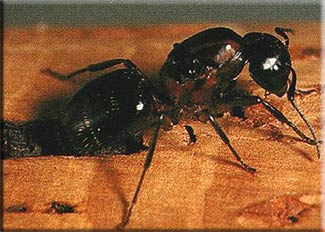
You take several tons of dead wood and assemble them into a house and then you see termites.
But what's a termite to think? They were here a long time - millions of years - before you were and they eat dead wood.
So building a big pile of dead wood is an open invitation to termites. They're very myopic and probably don't recognize that they're gnawing into an artificial structure. But even if they had sharp eyes and bigger brains the house wouldn't look very different from a freshly felled tree trunk.
At some point ants appear. They're foraging and find a place with water and carbohydrates of all kinds. (Your kitchen).
Again, ants have been looking for food since the dawn of time and they're just acting naturally. Same goes for earwigs, silverfish, centipedes, spiders, bees, wasps, and most other insect intruders.
Humans are semi-responsible for two vermin. Wherever we go cockroaches and rats follow. The brown and German roaches only live in proximity to people. Rattus rattus also doesn't venture far from our inevitable squalor.
Blattus and Rattus probably aren't conscious of humans either.
It's like some super-intelligence built McDonalds' on every corner for reasons we can't comprehend, and then tried to crush us or kills us with nerve gas every time we went there for a Quarter Pounder.

Monday, June 19, 2006

Attack of the Tick Monster


Crab monsters are hardly any problem these days.
Few buxom blondes are born away by enormous arthropods. What we have to contend with are crab's least likeable relatives, the ticks.
Crabs serve some ecological purpose. They consume detritus and other bits and pieces of stuff that other benthic organisms reject.
They're also a food source for octopuses and squids. And who knows, probably bigger crabs, too.
If crabs suddenly vanished from the seas, there would be consequences. Something unpredictably bad.
Consider the same exercise with ticks. No animals that we know of subsist on ticks.
Anteaters eat ants, which don't even taste good. Almost all organisms are consumed by other organisms. Mosquitoes provide food for birds, bats, reptiles and spiders. But ticks?
A creature that did eat ticks would have a difficult time finding them. They aren't a social insect, like ants. They're solitary and difficult to locate. And once captured, there isn't much to a tick unless it's engorged with blood.
Nature, in its wisdom, has eliminated the middle-man. Animals that live on blood take it directly from the source (leeches, bedbugs, mosquitoes, vampire bats, horseflies, and so on).
So, if ticks were no more, nothing would go hungry. Ticks don't even have fleas. Ticks, at their most benign, take blood and make more ticks. At their worst, they spread a variety of bacteria and protozoas.
This summer ticks are as thick as flies. They'll be with us until the daily high is 175 degrees and an absence of ozone bathes Earth in lethal ultraviolet rays. Even then, they will probably survive.
One need not believe in intelligent design to consider that ticks must be here for an important reason.
Once that becomes clear, it might shed light on the purpose of fleas.

Wednesday, May 3, 2006

Infant Morality

The high rate of infant mortality among black women in New Haven would be a less vexing question if the there were as many black women as whites, according to a concerned caller from Westville.

The rate of infant mortality among black women is about 2.5 times higher than the rate in white women. This is troubling because the figure seems to hold across socioeconomic lines, does not depend on the relative rates of cigarette smoking, or the amount and timing of prenatal care.

In other words, white mothers who smoked and neglected their health -- yes, stupid things to do -- still did not have an infant mortality rate as high a blacks.

But, the thoughtful man from Westville argued, a valid comparison between the races could only be made if equal groups of black and white women were studied. Black women have twice as many babies as whites, he alleged, which throws off the statistics.

The infant mortality rates are expressed as the number of deaths per 1,000 births.

"But," the caller said, "If you had as many black women they have twice as many babies so the statistics wouldn't be so bad."

The logic is subtle, in a dunderheaded kind of way. Twice as many babies, so twice as many infant deaths.

What we have here is an issue of what statisticians call "sampling." Sampling error would be including an abnormally high or low number of black women with dead babies. However, increasing the sample size only lowers sampling error a little. But infant mortality is a description of existing data, not an exercise in probability, as the Westville man believes.

Moreover, the mortality rate is stated as a common ratio, per 1,000. That scales up or down the results accordingly. So the unfortunate truth is that infant mortality is higher in the black than the white community.

Do all of these numbers seem impossibly dry and boring?

If so, get used to it and learn about it or stop offering opinions on matters of statistics.

Friday, February 17, 2006

Thinking Things Over

California researchers have discovered that -- brace yourself -- a single memory is processed in several sections of the brain.

This really should not be a surprise, considering the nature of memory.

Memories usually involve images, actions, perhaps sounds and smells, and an array of emotions. Remember, for example, your wedding day. Or, if you're single, ponder your last car crash. Anything significant.

You could probably write several pages. The question is, how is all of this information organized? Memories are cross referenced and linked to other memories.

So incoming sensory information that will become a memory probably has to be "deposited" in several places. And somehow the memory will be associated with events before and after.

Whatever is happening in the brain is beyond complex. The brain isn't a filing cabinet, or a hard drive, or a book.

It's probably more like a dynamic, shifting, replicating, duplicating, comparing, adding, subtracting, including, excluding, evaluating, ordering, disordering, holistic, interconnected, parallel, linear something or other.

The fact that we can even think about thinking is just too complicated to think about.

So, of course whatever a memory is, it enters the mind through more than one door.

Friday, January 27, 2006

The Lighter Side of Lung Cancer?

Smoking cigarettes is the worst single thing you can do to your body, especially if you're African-American.

Researchers at UCLA studied 183,813 African-American, Japanese-American, Latino, native Hawaiian and white-American men and women who smoked.

Over eight years 1,979 of these people were diagnosed with lung cancer. Not surprisingly, the risk was related to the number of smokes per day.

Among people who lit up 30 cigarettes a day, or less, African-Americans and native Hawaiians had a significantly higher risk of lung cancer. If you had to have cancer, lung is a bad, very bad, choice. People with lung cancer have a low five-year survival rate.

Over all, African-Americans and native Hawaiians are way more likely to get lung cancer.

The question is why.

The doctors controlled for differences in diet, physical activity, and other pertinent factors. Even so, blacks and Hawaiians are apparently more prone to lung cancer.

This is really puzzling because all of us humans originated in Africa (a long time ago) and only recently developed "racial" characteristics. The idea of races is scientific piffle, biologists say.

There are reasons for certain differences. If you live near the equator darker skin helps protect against skin cancer. We need sunlight to use vitamin D, which is why people at higher lattitudes with less sun have paler skin. Maybe.

That makes sense in a certain way. But what advantage does susceptility to lung cancer confer? Or is it really a stronger response to nicotine? More sensitive brains? Better sense of smell? All of those evolved long before the discovery of tobacco.

There have to be some real reasons why blacks and Hawaiians get more lung cancer. The alternative is "racial differences," which is merely a social construct of prejudiced white people. That conceit has never led to anything remotely positive.

It'll take a long time to figure all of this out. Meanwhile, if you want to avoid lung cancer -- regardless of how much melanin is in your skin -- don't smoke.