Tuesday, November 7, 2006

Death Takes A Job In A Hospital


U.S. medicine is increasingly expensive, filtered through unqualified insurance-o-crats and becoming less and less accessible.

But at least it's better than the medical system in Britain, where the chance of death by medical error is a breath taking 1 in 300.

Britain's senior doctor made the estimate recently. Presumably that's a lifetime risk.

That's about the lifetime risk in the U.S. of dying from gunfire, overdosing on narcotics, or falling down. According to the National Safety Council, the least likely accidental cause of death in the U.S. is by a snake or lizard bite.

The most common include car crash, self-inflicted gunshot (not really an accident, assault with a firearm, or the ever popular falling down.

In Britain, the average chap is 33,000 times more likely to die from a medical error in a hospital than in an air crash, according to the chief medical officer Sir Liam Donaldson. "In an airline industry, the evidence ... from scheduled airlines is the risk of death is one in 10 million. If you go into a hospital in the developed world, the risk of death from a medical error is one in 300," he said.

Perhaps Donaldson is counting the number of people who die in hospitals, which these days, includes most of us. Otherwise, he's defining medical error in a ridiculously broad way.

The message seems to be that if you want to avoid dying in a hospital, spend as much time as possible flying in an airliner.

Wednesday, October 25, 2006

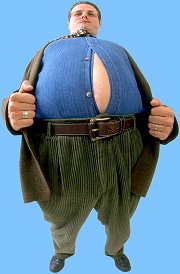
Mean Comments Don't Help the Overweight


Yale diet scientists have discovered that nagging people about being overweight is not helpful.

In fact, stigmatizing those on diets makes them abandon the diets and seek more food. Many people would respond to this study with an obtuse "Duh."

Of course overweight people don't want to be teased and made to feel like self-saboteurs. Though this seems obvious now, that response comes after decades of treating the overweight as social and physical pariahs.

So, "Duh" really marks an advance in thinking. It seems as if people are finally realizing that obesity is not an abject absence of self-control and a failure of free will.

This is not to say that obesity is healthy. It isn't. But clearly, shame does more harm than good.

Tuesday, October 24, 2006

Bore Not, Blog Not


Good grief.

Is this as boring as all of the other blogs? You bet! Even the notable ones. Are any blogs interesting or are we all deluding ourselves?

Or boring ourselves on purpose as an escape from the devised, depraved existence in which we find ourselves.

Boredom is a saving grace. We spend four years in college learning how to be politely bored. Boredom is what sets humans apart from other animals. They learn, anticipate, plan. But do they get bored?

No. That's our one true human traint. Boredom is not mindless. It's too much mind.

Are you bored yet?

Blah, blah, blah. Of course you are.

Here we have graphic proof that only the thoughts of a very few people are interesting, valuable, or revelatory. Fernando Pessoa had original perceptions. The rest of us? Blah.

Denis Johnson? Yes. You? No.

But don't fool yourself. Boredom is valuable. It gives you something to do. Otherwise you'd be wasting your time. Boredom is truly yours and yours alone. That's one thing no one can take away from you.

It's reliable and effortless. And people envy the truly bored.

So, go ahead. Be bored.

Just do it the right way.

Clang! Coumadin Time!


An astounding 700,000 people in U.S. poison themselves every year by taking the wrong medicine, too much of the right medicine, or because of an adverse reaction to a medicine.
Adverse drug effects accounted for 2.5 percent of emergency department visits in the years studied by the U.S. Centers for Disease Control and Prevention.
The main problem seems to be confusion. Patients take an over-the-counter or prescription pill, forget, and then take another too soon.
Some drugs, such as blood thinners and medications for diabetes, were especially prone to accidental misuse.
But can that number possibly be true? That's almost 1 million Americans. Or about 0.3 percent of the population. So, yes, it does make sense.
Imagine you take six drugs a day; one three times a day, another when you wake up and go to sleep; another every four hours, a second drug three times a day and as needed, another taken as needed or every two hours, and another than can only be taken with food.
How could you not be confused? Here's where a robot could really be useful. Load all of the drugs into the machine. After each load, enter the information about when the drug should be taken. The machine would also have an "as needed" button, but the robot would keep track of how many times it's pushed.
The robot would have a sound alarm and flashing light. The pills would emerge from a shoot, like a gum ball machine. The machine could only be opened with a key that's in the possession of the person in charge of keeping the robot supplied. It would run on electricity and also contain emergency batteries.
This shouldn't be too hard to design.
In fact, you could simply take the machine to the pharmacy. Simple.
Or, you could not smoke, stay slim, exercise, not drink in excess, have good genes and no family history of heart disease or cancer.
That's the ticket.

Political Lunacy


A social worker at Southern Connecticut State University has completed a study showing that support for President George W. Bush is especially high among the mentally ill.
In fact, the more severe the mental illness the greater of support. Christopher M. Lohse, the researcher, also discovered that Bush supporters showed a lower understanding of current issues, politics and government than non-supporters.
The study involved 69 psychiatric outpatients in the 2004 presidential election. The subjects completed various tests to measure their impairment.
"The funding that political preference for George Bush was associated with poor mental health is consistent with previous research on voting preference and mental illness," Lohse wrote, based on a paper published in 1977 by Frumkin and Ibrahim in "Perceptual and Motor Skills."
This appears to be a serious study, but releasing it two weeks before the election betrays a certain partisan bent.
How the mentally ill perceive the world is interesting, however. Unfortunately Lohse does not reveal the diagnoses of the 69 outpatients.
Maybe psychiatric patients have some political predictive value.
As the schizoids go, so goes the nation!

Monday, September 18, 2006

If I Were A Hyena I'd Eat Your Head


Snoring is definitely not an evolutionary advantage.
A few hundred thousand years ago emitting a sound like a lawn mower every few seconds would draw every predator within ear shot.
And the snorer is as his most vulnerable. He'd wake up with sabre tooth tiger fangs sticking out of the back of his head.
Snoring is apparently another one of those unexpected results of civilization. We can now safely snore, in the sense that we need not worry about hyenas with sharp ears.
However, loud snoring is associated with obstructive sleep apnea. This is a condition in which your floppy soft palate seals off your windpipe, almost waking you up, over and over and over.
It increases the risk of heart problems, high blood pressure, and falling asleep at any opportunity, sort of like the actors in the mattress ads.
There are non-surgical ways to effectively treat sleep apnea. Basically, you strap a mask over your face connected to a pump that blows air down your throat all night.
What does not work are devices designed to pull your nostrils open. Of course open nostrils are good, but snoring has zippo to do with the nose, and everything to do with the floppy tissue at the back of your throat.
For cripe's sake, get a mask.

Tuesday, September 12, 2006

Mad Dog or Thunderbird, Sir?


Either a wonderfully dry group of satirists has been born - or a bunch of crackpots with a harmful agenda is at work.
They call themselves the Reason Foundation, which is already kind of funny.
The foundation's latest e-mail report purports to demonstrate that people who drink heavily earn more money than social drinkers and those who abstain.
This contradicts common sense, but common sense isn't always correct. The foundation clowns instead use a nonsensical equation and impossible to interpret data sets to "prove" its hypothesis.
This is a real-life example of what you should learn math. Someone, somwhere will read and believe the report and start bringing a bottle to work and keeping a short dog in his jacket.
That's what all of the successful people do. You can see them lounging outside on the curb at night or sleeping in cardboard boxes.
There's nothing wrong with sensible drinking and it may even be OK to overindulge occasionally if someone sober can drive you home and dump you on your front lawn.
Reason Foundation, meet "the aristocrats."