Tuesday, October 24, 2006

Political Lunacy


A social worker at Southern Connecticut State University has completed a study showing that support for President George W. Bush is especially high among the mentally ill.
In fact, the more severe the mental illness the greater of support. Christopher M. Lohse, the researcher, also discovered that Bush supporters showed a lower understanding of current issues, politics and government than non-supporters.
The study involved 69 psychiatric outpatients in the 2004 presidential election. The subjects completed various tests to measure their impairment.
"The funding that political preference for George Bush was associated with poor mental health is consistent with previous research on voting preference and mental illness," Lohse wrote, based on a paper published in 1977 by Frumkin and Ibrahim in "Perceptual and Motor Skills."
This appears to be a serious study, but releasing it two weeks before the election betrays a certain partisan bent.
How the mentally ill perceive the world is interesting, however. Unfortunately Lohse does not reveal the diagnoses of the 69 outpatients.
Maybe psychiatric patients have some political predictive value.
As the schizoids go, so goes the nation!

Monday, September 18, 2006

If I Were A Hyena I'd Eat Your Head


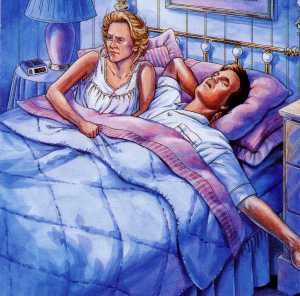
Snoring is definitely not an evolutionary advantage.
A few hundred thousand years ago emitting a sound like a lawn mower every few seconds would draw every predator within ear shot.
And the snorer is as his most vulnerable. He'd wake up with sabre tooth tiger fangs sticking out of the back of his head.
Snoring is apparently another one of those unexpected results of civilization. We can now safely snore, in the sense that we need not worry about hyenas with sharp ears.
However, loud snoring is associated with obstructive sleep apnea. This is a condition in which your floppy soft palate seals off your windpipe, almost waking you up, over and over and over.
It increases the risk of heart problems, high blood pressure, and falling asleep at any opportunity, sort of like the actors in the mattress ads.
There are non-surgical ways to effectively treat sleep apnea. Basically, you strap a mask over your face connected to a pump that blows air down your throat all night.
What does not work are devices designed to pull your nostrils open. Of course open nostrils are good, but snoring has zippo to do with the nose, and everything to do with the floppy tissue at the back of your throat.
For cripe's sake, get a mask.

Tuesday, September 12, 2006

Mad Dog or Thunderbird, Sir?


Either a wonderfully dry group of satirists has been born - or a bunch of crackpots with a harmful agenda is at work.
They call themselves the Reason Foundation, which is already kind of funny.
The foundation's latest e-mail report purports to demonstrate that people who drink heavily earn more money than social drinkers and those who abstain.
This contradicts common sense, but common sense isn't always correct. The foundation clowns instead use a nonsensical equation and impossible to interpret data sets to "prove" its hypothesis.
This is a real-life example of what you should learn math. Someone, somwhere will read and believe the report and start bringing a bottle to work and keeping a short dog in his jacket.
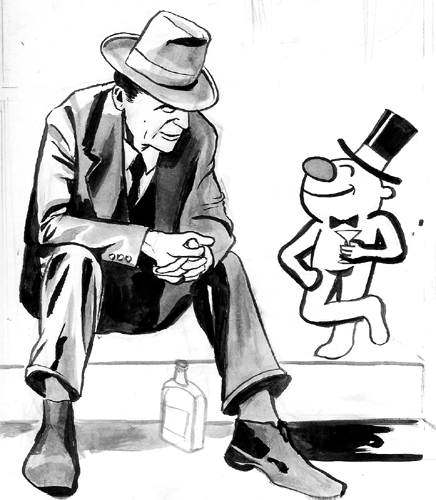
That's what all of the successful people do. You can see them lounging outside on the curb at night or sleeping in cardboard boxes.
There's nothing wrong with sensible drinking and it may even be OK to overindulge occasionally if someone sober can drive you home and dump you on your front lawn.
Reason Foundation, meet "the aristocrats."

Sunday, September 10, 2006

Adding Insult to Injury

What better way to insult the memory of the dead and hurt the living than to perpetuate the idea that 9/11 was somehow a "hoax?"
What could be more cruel to the firefighters, police officers, steel workers, and everyone else who endangered themselves by working in the wreckage?
And finally, how gullible are we ultimately?
Many people still wonder who was behind the assassinations of the Kennedys and Martin Luther King Jr. Conspiracies seem possible because only a few people, if any, witnessed the events.
However, tens of thousands of New Yorkers and thousands of people in the Beltway watched 9/11 as it happened, in real time. Millions more saw endless videotapes of the tragedy from dozens of different angles.
Could a passenger jet have fired a missile at the World Trade Center tower without anyone noticing? Only now do we see images of "bulges" or "pods" under the wings. But no one saw the alleged weapon.
Workers in the towers did not see crews planting explosives on girders before the fact. No one claims to have seen a cruise missile or a fighter jet crash into the Pentagon.
All we are given is misinformation after the fact. Fuzzy images. Blurry thinking.
Circumstantial nonsense.
After five years they only seem to be getting started.
It's pathetic.

Saturday, September 9, 2006

That Morning

My wife often calls me from work in the morning to make sure I'm at least half awake and gurgling with coffee.
Usually she tells me an interesting odd fact or asks an esoteric question from her officemates.
On this morning I recognized the ring and dutifully answered the phone. She sounded agitated. All I could make out was "The World Trade Center," and "Someone crashed into the World Trade Center."
"What?" I said. This was going too far. And strange.
"Turn on the TV," she said, and hung up.
The Sony buzzed to life and I saw what everyone else was watching that morning. The network was showing replays and replays of replays of what happened minutes before. Huge jets. Twenty-story fireballs. Debris filling the sky. Miles and miles of smoke.
I sat on the floor in a patch of sunlight and watched, bewildered.

Wednesday, August 23, 2006

Hey, Give me another quarter of a second!


According to psychologists at Princeton University, we judge the character of a new face in one-tenth of a second.
Specifically, 200 college students who viewed photographs decided whether the person imaged was attractive and trustworthy in less time than it takes to sneeze.
Given more time to think, the decisions only became firmer.
Other scientists have determined that in cultures around the world, what is considered most attractive is an average of the population features. That is, a nose too long or too short was not ideal, but the nose in the middle was.
So, what the Princeton students were deciding in a split second was how closely the faces were to our idea of beauty. And our idea of beauty is essentially the least extraordinary.
Beauty and truth, as John Keats poetically pointed out, are closely entwined, making it easy to see why attractive people seem more trustworthy.
Also, being able to decide instantly whether a person is likely to be friend or foe is a clear advantage in survival and mating.
However interesting this research is, it ignores what makes humans human: language. We may find someone attractive until she starts to talk. Likewise, someone may seem unattractive, but he might have a great sense of humor (which women claim to find attractive.)
If you look in a mirror, what do you think?

What Me Worry?


Fear's a funny thing.
We tend to have a cockeyed list of worries.
We fear death, although as far as we know, everyone's doing it.
We worry about who's going to win "American Idol," or what's going on with the people on "Lost."
We worry about why our next door neighbor's lawn looks like a putting green, while the one behind the house is a ragged patch of Mohave Desert.
Can we afford to send our daughter to college? Can we afford obedience school for the dog? We worry because we do not understand what the financial planner is talking about.
Was it a mistake to paint the new window glazing with latex primer?
Most of those aren't worth the adrenaline.
To mis-paraphrase Franklin D. Roosevelt loosely, what we have to fear the most is what other people fear.
Prevention magazine presumably conducted a poll or lifted numbers from a government report on the five top health fears of women.
The number one fear is breast cancer, followed by HIV/AIDS, Alzheimer's disease, and ovarian cancer. What they should worry about is heart disease, stroke, lung cancer, chronic respiratory disease, and diabetes.
Why not worry about all 10?
If you really want to worry about something, consider that according to Prevention, 61 percent of people queried said losing a pet would be more traumatic than getting laid off.
(These are people who've owned a pet -- but never been fired.)